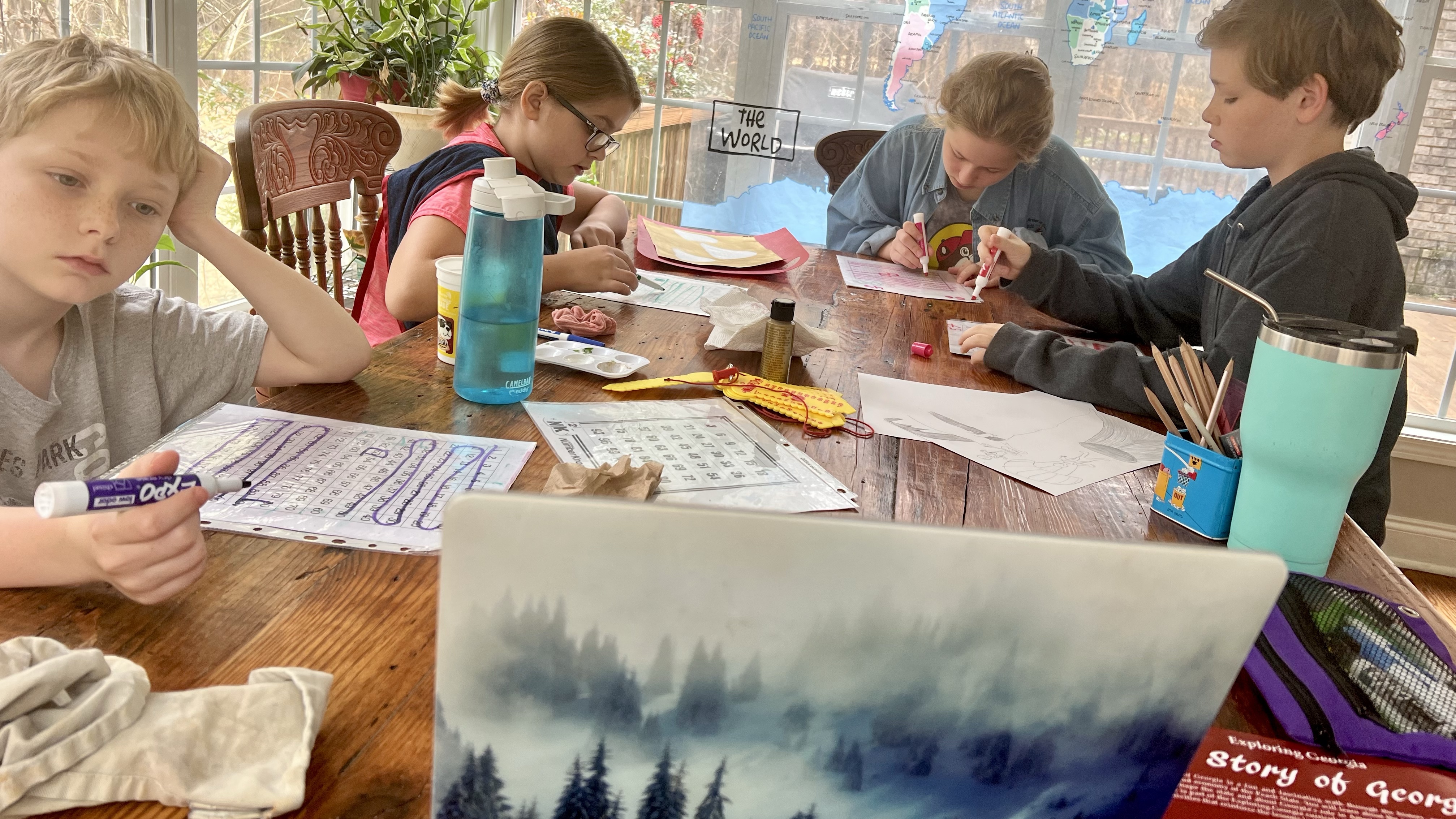
Classical Conversations and unschooling each bring something unique to the homeschool family; combining this unusual pairing can create a dynamic homeschooling experience. Classical Conversations (CC) offers a strong, structured foundation; unschooling allows for child-led curiosity to drive at-home learning. You don’t have to pick one homeschool plan. When used together, these homeschool methods can foster a personalized home education that will empower your homeschool child to take ownership of their learning journey. You don’t have to pick one or the other!
You love the idea of unschooling but want a more structure. Try combining CC and unschooling. This homeschool guide will show you how to embrace the flexibility that unschooling adds to CC’s classical education model. These superficially different approaches complement each other to create an enriching environment that respects both structure and spontaneity.
Over these ten years as a homeschool mom, I’ve learned to lean into wise, real-world experienced homeschoolers to help me on my homeschool journey. Keep reading and let me keep you from making the same mistakes.

Understanding the Unschooling and Classical Conversations
Let’s start off by staying that defining homeschool methods drives me crazy. Homeschool moms can be very defensive. I’ve seen too many online arguments as homeschoolers bring down other homeschool families who aren’t purely Charlotte Mason or argue that Classical Conversations isn’t a true classical model…. And on and on.
Don’t be those people. Everyone pulls from all homeschool philosophies. As my CC Challenge kids have learned in debate, before discussing anything we need to “define our terms.”
What is Unschooling?
Unschooling embraces a child-led, curiosity-driven approach to learning at home, often without a formal homeschool curriculum. To an outsider, it looks very different from traditional schooling as hands-on activities, rich books, home projects, and field trips replacing structured lessons. Each family interprets unschooling uniquely, creating an environment that nurtures a child’s ability to teach themselves anything and everything.
This method lets learning happen organically, recognizing that children are born curious and eager to explore. Just as you’ve guided them since infancy, answering their “why” questions and seeking answers together, unschooling continues this process, encouraging creativity, independence, and a lifelong love of learning.
~~~> If you’re just now diving into the world of homeschool, check out the list of all my homeschool related blog posts at https://reclaimingwonders.com/homeschool/

What is Classical Conversations?
Classical Conversations is broken into three stages which are based on the classical model of education. In Classical Conversations (CC), this layered learning means that by junior high and high school, students are building upon the Foundations program memory work they’ve worked on since elementary. Until 7th grade (Challenge A), there are no formal weekly schedules, assignments, or grading, allowing parents to tailor their homeschooling as they like. Weekly CC meetings allow “homeschool socialization” and friendship opportunities in a fun learning environment for the whole family. The rest of the week is yours!
CC Grammar Stage: These elementary age Foundations kids focus on memory work on a three year cycle. This is when “pegs” are formed as they become familiar with terms and ideas. The same topics are returned to several times during their Foundations years allowing for a deeper exploration as the kids’ understanding grows. It’s amazing how the introduction of a simple song or hand-motions allows that familiarity with a word; now the kids will hear it in the world and can further make associations. They also give weekly small group presentations, have weekly hands-on science projects, and are introduced to drawing, music, composers, and famous artists.

Dialectic Stage: In upper elementary and middle school (Challenge A and B), kids develop reasoning and critical thinking (ages 12-15). Their memory pegs are now being discussed in groups in class, and debated through their natural tendency to ask questions.
Rhetoric Stage: High school years in the Challenge program level I-IV allow them to debate what they have learned (ages 15-18). They lead their class in discussion, presenting to their peers what they have learned while spending one day a week learning from each other. Conversations are the key here.
~~~> Make sure you check out all my info about how my family has used the Classical Conversations curriculum for the last ten years: why we’ve used CC for ten years, how the Essentials program works, and how Challenge works in the high school years.

How Do I Adapt Classical Conversations to Unschooling?
Mindset is a word that I embraced several years ago, and it’s so important to the homeschool family. See the whole world as your classroom, nothing off-limits. Now sooo much of your day counts as some form of learning. Joining the good of CC and unschooling allows you to take the best of both worlds to create a truly unique homeschool life.
1. Use CC as a Resource, Not a Requirement
Remember that the Classical Conversations curriculum is a guide and not a daily homeschool check list. If you’re looking for a daily step-by-step curriculum, you aren’t going to find it here. And no one is going to kick your child out of the program for not being “prepared” every week.
The CC model introduces new material at community day to practice the following week at home. Apart from a bit of encouraged review of previous material and their weekly class presentation, there is nothing to prepare before class.

2. Follow the Child’s Interests
The Foundations memory work can be practiced and reviewed in a max of thirty minutes. Apart from this (and the Essentials papers in the 4-6th grade ages), your week is free to adapt the CC facts around a child’s natural interests. If they love animals, explore the science topics on animal habitats or ecosystems. If they’re fascinated by history, dive deeper into the historical figures or time periods presented in CC.
The CC memory work will spring-board more learning and activities sparked by CC lessons. They learned knew words and people and placed. Even if they have no idea what they mean, they will be more interested in learning about them. Even if that just means watching a ten-minute You Tube video about history while waiting for dance class to start. It totally counts! If they want to learn about something not from CC, that’s okay too! Just follow any and every trail.
Learning to homeschool means having lots of conversations. Listening to their questions. And answering them. If you don’t know about something – keep it simple! – pull out the phone and look it up.
~~~> I’ve created the ultimate homeschool mom gift guide! Books, travel and nature supplies, homeschool supplies, and more. Save this, share it with your family and friends, and let’s use these homeschool gifts to encourage other homeschool moms.
3. Be Flexible with the Weekly Memory Work
Every CC family makes it work for their family uniquely. Pinterest boards and CC discussions make it look like every CC family spends thirty minutes daily happily reviewing their weekly memory work. Photos show Mom with her beautifully displayed timeline cards and the giant dry erase board of memory work for the week.
However, this is far from the truth. Every family is different. Some CC families don’t touch the memory work apart from singing songs in the car. The amount of time spent “doing” CC the rest of the week depends on the season of life. Busy sport life, family illness, or work schedules may make one week even busier. CC adapts well!

4. Allow Self-Directed Learning
Self-directed learning means that the kids have free-time and access to lots of learning opportunities. But not the kind on a strict required schedule. Kids will learn even without you getting in the way!
Let them have fun learning. If they are only interested in a few days, let them move on. They still learned in that short time. Kids who enjoy learning won’t fight you as much when it’s time to do some harder subjects.
Encourage the kids to learn more through books or projects or movies. These independent projects reinforce knowledge while fostering autonomy. And it reminds them that they don’t have to “be the same” as all the others in the family. It’s okay for them to not be interested in the same stuff as their big brother.

5. Incorporate Hands-On and Outdoor Learning
Don’t go buy all the textbooks related to the CC subjects of the year. Let it flow naturally. Be spontaneous. Keep a list of ideas. And keep it simple!
- Teaspoons and tablespoons? Bring in some real world cooking or water play with mom’s kitchen supplies.
- Invertebrates and vertebrates? Head to the zoo or local pet store.
- Learning about Egypt’s geography? Make that Barbie mummy and find the closest museum with a real mummy!
- Memorizing the parts of the ocean floor? Skip a week of CC and head to the beach. (No one will penalize you for prioritizing family vacation! I would know. I’m great at it.)
~~~> My favorite way for hands-on learning is definitely through travel. Check out these detailed family trip to Yellowstone and ultimate Virginia road trip itinerary.

How Does Unschooling Make CC Better?
Unschooling Helps You Let Go of Rigid Expectations
Honestly, some Classical Conversations families are a little over the top. Don’t dive into the world of Pinterest boards and Facebook group. You will leave feeling that you aren’t doing everything that “everyone” is expecting of you. Let those expectations of yourself go away. And, if you have a well-meaning homeschool friend or family member who is telling you that you’re “doing it wrong”, you might want to let them go as well… Or gently remind them that every family is different. There is no CC police group who will report you.

Unschooling Helps Let Go of the CC Perfectionism
Don’t worry about “keeping up” with CC’s structure. Remember that the blessing of unschooling is that you can follow your child’s unique pace and interests. If your kid wants to spend three weeks learning all about plants and doesn’t ever get to “stinging-celled animals”, it’s okay. You yourself went to school for more than a decade, and can you name some stinging-celled animals?
I suggest you try to follow the CC plan some, but if your weeks don’t line up, it’s okay. If you have lots of books about life in Ancient Rome and not a lot for Egypt, it’s okay. Let it go.
Unschooling Helps You Find Non-CC Friends
Just like with any friend groups, you’re not going to click with everyone. And that’s okay. Bringing other homeschool methods into your life allows your to embrace common ground with different types of families. Your new non-CC friend may be a memory work queen at home, but love weekly Charlotte Mason nature walks. Do your CC songs in the car on the way to meet her on the hike.
No matter how your learning at home looks, you both love the freedom of your wild and free kids running up the mountain. Balance each other out.

Unschooling with CC Balances Structure and Freedom
Unschooling with help you change your Classical homeschool structure to a “flexible framework” with general weekly goals. This leaves room for spontaneous learning. For example, instead of a strict daily schedule, you can have a morning routine with CC activities and the rest of the day of unschooling time for individual exploration.
Many homeschool families gather around a table for a morning meeting or table time for some group learning. Set this as a regular routine, and allow the rest of your day to include a basic check list with lots of time for outdoor playing, games, and beautiful books.
~~~> Wondering how playing games can count as part of your homeschool learning day? You need to read “Gameschool: How to Have Fun in Your Homeschool.”

How Does Adding CC Make Unschooling Better?
CC Gives You a Homeschool Group
The group setting and weekly community days are one of the aspects of Classical Conversations that I love the best. Not only does it get my kids some amazing friends, but I know the friends and their families and can fully allow out-of-school play time.
However, the more CC families you meet, the more you may be tempted to compare yourself to how it appears their super-star CC kid is memorizing everything. Learn to support other families’ methods while not taking it personally that they’re different. That doesn’t mean you’re doing it wrong (or that you need to point out how they’re doing it wrong); you’re just doing life differently.

CC Gives You Accountability
I admit that I will never be a full unschooler because I need some accountability. I need to know that my child’s tutor might realize that my kid knows none of his memory work. Although they aren’t going to reprimand me for being a slacker mom, I definitely have an inner need for someone else to give me that imaginary check mark.
As an Essentials tutor, I have seen how the act of turning in a paper to someone other than mom, gets things done. Having another grown up makes things get done. CC allows me to unschool while knowing that we will get things accomplished. (This is also why math often doesn’t get done here because no one is checking it outside the home!)
CC Allows for a Variety of Teachers
The tutors and directors in CC programs are an amazing way to have your kids surrounded by loving adults who aren’t their parents. My children have made some amazing relationships with other moms and dads. I know they would do anything for my family. In the middle school and high school years, the Challenge directors are the “teachers”, but they’re also the lead learners. What fabulous opportunity for our kids to see awesome adults still learning and growing.
The kids are engage regularly with other adults. They have respectful conversations about differences and the world which helps them realize that not everyone sees the world as your family. Let them see that other people approach life differently… That they can “be friends” with adults and people of all ages. (That definitely doesn’t happen in regular school!)

Unschooling and CC can work together beautifully if they’re open to flexibility. Emphasize the freedom you have to adapt both methods to fit your family’s needs. Focus on your children’s passions and progress rather than a checklist, creating a meaningful and individualized learning experience.

Thanks for stopping by my little corner! Here’s to your next adventure.
I’m Bobbie. As transplants from Texas, my family of six is on a mission to discover all of Georgia’s amazing places, experience amazing road trips across the United States, and create a homeschool life along the way.
Want to adventure like me? Reach out! I’d love to chat. Stop by my Instagram or Pinterest page to discover more of our adventures.
Want to work with me? I’d love to work with your destination and tourism board to help other family travelers see all you have to offer.
Leave a Reply