A St. Augustine vacation is waiting for you. As Florida’s oldest city, Saint Augustine is easily walkable – full of history, charm, and waterfront views. You can visit St. Augustine Florida and not spend a dime to enjoy it. You just need to know the best St. Augustine free attractions. Your family Florida road trip just got even better with this list of more than 20 free things to do in St. Augustine with kids. Keep reading!
With unlimited St. Augustine tourist attractions, it’s not a question of “what to do in St. Augustine” it’s a question of how to best explore the St. Augustine attractions in a way that the family (and budget) enjoys.
St. Augustine is living museum of American history. Unique things to do in St. Augustine include the imposing Castillo de San Marcos, the charming colonial-era homes, and walking the iconic St. George Street. We will step inside historic churches, admire the city’s Spanish architecture, visit free museums, and let the kids explore a St. Augustine beach. Our Florida road trip spent a day in St. Augustine; here’s how we did it!
~~~> Planning your family Florida road trip? Check out this detailed list for more top places: “30+ Florida Places You’ll Love for your Family Road Trip.“

St. Augustine Guide FAQs
As a peninsula, St. Augustine is surrounded by water. Looking east from the St. Augustine Fort, you see the Matanzas River which leads to the Atlantic Ocean and barrier islands (and Fort Matanzas!). This is where you head for wide, sandy beaches ideal for swimming, shelling, and sunrise strolls. On the opposite side of St. Augustine runs the Intracoastal Waterway, offering calm waters for boating, kayaking, and dolphin spotting. This is all surrounded by marshy inlets and historic charm. St. Augustine is ideal for water fun of any type.
Where is Saint Augustine, Florida?
If you look at a map of Florida, head right to the top right corner – there’s St. Augustine. Located just about 30 miles south of the Georgia state line, it’s an easy three hour drive from St. Augustine to Savannah along the Georgia coast. It’s a popular weekend trip from Atlanta (for myself and my friends) as it sits right off Interstate 95, the main highway that runs along the East Coast. If you’re flying in to visit St. Augustine, it’s a simple drive from the closest airport in Jacksonville (one hour away).

Right on Florida’s east coast, it’s popular among boaters who can follow Florida’s Intercostal Waterway all the way up from Miami. If you’re coming to Florida to visit Disney World, consider driving two hours north from Orlando to St. Augustine. It’s a do-able day trip or weekend getaway. PS: It’s also close to one of the few Florida Buc-ee’s rest stops; fill up the car here on your way out of town (and read why you should go on this Bucee’s post).
Why is St. Augustine Important?
The history of St. Augustine, Florida is impressive. It is the oldest continuously inhabited European settlement in the United States, founded by Spanish explorer Pedro Menéndez de Avilés in 1565. Long before the Pilgrims landed at Plymouth Rock, this coastal city was a thriving Spanish outpost, serving as the capital of Spanish Florida for over 200 years.


Its strategic location surrounded by several waterways made it a target for pirates, British attacks, and shifting colonial powers. With the help of the Castillo de San Marcos it endured, leaving behind a rich blend of Spanish, British, and American influences in its architecture, culture, and traditions. Today, St. Augustine offers visitors a fascinating glimpse into the past with its well-preserved historic district, cobblestone streets, and centuries-old landmarks.
Where Do I Park in St. Augustine?
For families visiting downtown, parking at the covered parking garage next to the St. Augustine Visitor Center is a easy. With over 1,000 spots, it’s the most convenient and affordable way to access the historic district without the hassle of circling narrow streets. For a flat fee, you can leave your vehicle all day—freeing you to walk, explore, and stop for snacks or rest breaks whenever your kids need.

If you’re looking for St. Augustine family activities and only want to see a few places, this parking garage is just steps away from major attractions like the Old City Gates, Castillo de San Marcos, and St. George Street. While there are lots of street parking options throughout the historic district, they are hard to find. When you park here, you’re situated right at the St. Augustine tourist center; it makes a day easy.
However… This is not centrally located if you’re heading out to wander. It’s at the north end of all the other stops on this St. Augustine walking tour. Take everything you need with you because it won’t be a quick walk back to your car.


St. Augustine Visitor Center
Homeschool travelers and historians will love the inside of the St. Augustine Visitor Center. This isn’t just a place to get a map – do it! – but a great little free history museum. Plan to spend about thirty minutes reading the history of St. Augustine and looking at the exhibits. The ship is impressive!
This is also the place to use the restroom and fill up the water bottles before heading out to see St. Augustine.

Fountain at Visitor Center
Just outside the St. Augustine Visitor Center, the courtyard fountain offers a peaceful moment to pause before heading into the city. With its bubbling water and well-landscaped area, the fountain is a favorite place for families to snap a photo and take a breath before beginning their walking tour. On warm Florida days, the shaded benches nearby give everyone a break from the sun.

Old Spanish Trail Marker
Contrary to what you would think, the large concrete sphere marking the Old Spanish Trail right next to the visitor center fountains doesn’t mark the beginning of the actual Spanish Trail used by Spanish Conquistadors centuries ago. But one didn’t exist.
This Old Spanish Trail was a driving road that lead from St. Augustine across the United State to San Diego actually wasn’t built until the beginning of the 19th century. Still a cool historical marker; just not that old in history.

Historic Cemetery
Right next to the fountains, you’ll see the Huguenot and Tolomato Cemeteries (or St. Augustine Public Burying Ground) before reaching the impressive St. Augustine city gates. Although typically closed to the public, families can walk by and peer through the wrought iron fences to view centuries-old tombstones and Spanish-style markers. As a predominately Catholic city, this burial ground was established for burial of Protestants and was used from 1821-1884.
Use this moment to talk with kids about how beliefs and early settlement life impacted communities hundreds of years ago. Or just read some dates and say “Look how old the city is!”. They won’t be impressed, but you can try. 🙂

Castillo de San Marcos
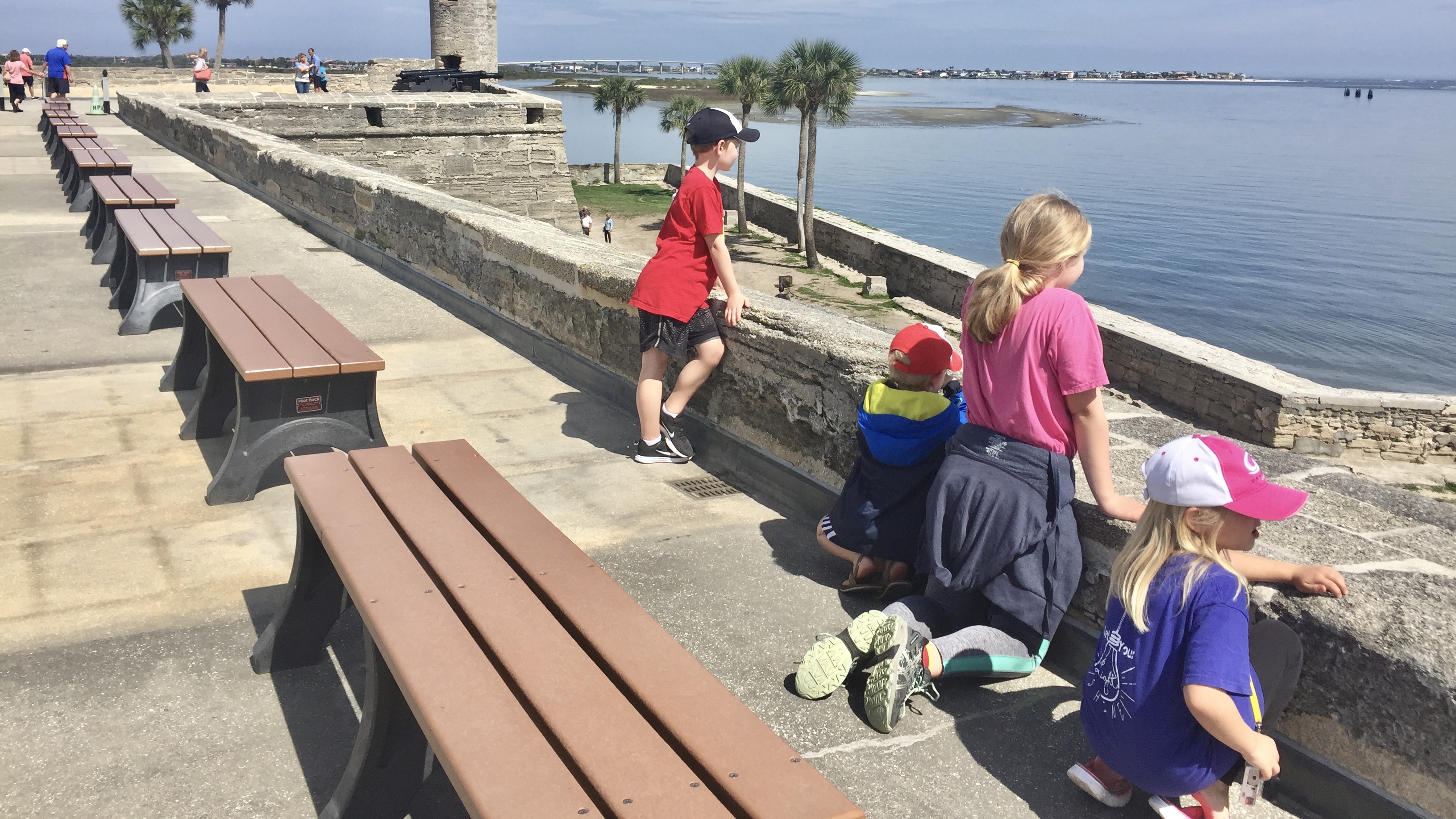
The Castillo de San Marcos National Monument is the oldest masonry fort in the continental U.S., and one of the most visited attractions in St. Augustine. Constructed by the Spanish beginning in 1672 from coquina stone—a local mixture of shell and limestone—the fort was built to defend the city from pirate attacks and enemy European powers. Located right at the junction of the Matanzas River and the waterway, this St. Augustine fort’s location was essential to defend St. Augustine from multiple directions. (This is the Matanzas River that flows south to Fort Matanzas – add it to your Florida list!)

While entry into the Castillo requires a ticket, the entire exterior and surrounding park are free to explore. Families can walk the perimeter, take in panoramic views of Matanzas Bay, and often see reenactors in period dress demonstrating cannon fire or colonial military drills. Kids can run up the grassy earthworks and imagine what life might have been like for soldiers living here in the 1700s. It’s a must-see, whether you go inside or not.
Although we didn’t get Castillo de San Marcos tickets this trip, we have entered before. If you have time during your St. Augustine family vacation, plan to spend a couple of hours here and learn the history. Tickets will cost you $15 a person, so you might as well get the America the Beautiful pass! And if you have a 4th grader, make sure you get the Every Kid Outdoors Pass – you need to make sure you print ahead of time!
~~~> Love visiting Florida’s forts? Head to nearby Fort Matanzas; all you need to know in this recent Fort Matanzas post.
Walk Along the Matanzas Bay
Walking along Matanzas Bay toward the Bridge of Lions is one of the most scenic—and stroller-friendly—walks in St. Augustine. This iconic drawbridge was completed in 1927 and features statues of marble lions at either end, symbolizing strength and the city’s Mediterranean influence. From here, you’ll see watch the boats and look for dolphins!

It’s an ideal route for families who want to enjoy the coastal breeze and take beautiful photos with the fort, city gates, and waterfront in the background. If you’re lucky, you’ll catch the bridge rising for passing boats—a fun sight for kids fascinated by moving structures.
Old City Gates to St. George Street
The St. Augustine Old City Gates once marked the official entrance to colonial St. Augustine and date back to the early 1800s. Constructed of coquina stone (limestone made of shell fragments), these gates are all that remain of the city’s original defensive wall system. Just beyond lies St. George Street, the most famous pedestrian street in the city, filled with shops, historic buildings, and street performers.

Walking through the gates with your kids is like entering a different century. Encourage them to imagine life during the Spanish and British periods as you stroll through the heart of the old town. The street is packed with free sights and historical markers, making it both fun and educational for families.
Oldest School House
Right through the gates, you’ll see the oldest wooden school house from before 1763 in the right on St. George street. If you want to enter the building, you have to pay entrance for the Oldest Wooden Schoolhouse Historic Museums and Gardens. It’s free to read the signs and walk by as we did!

St. George Street and the Colonial Quarter
To see St. Augustine for free, you need to enjoy the outside of the buildings, reading plaques, and peeking in doorways. In St. Augustine’s historic district, the Colonial Quarter is a living history museum is a paid attraction that showcases three centuries of life in Spanish and British colonial Florida. Though full access requires an admission fee, families can still enjoy parts of the experience just by walking by. From the street, you can often catch blacksmiths at work, hear musket demonstrations, or see actors dressed in period clothing.

This area sits on land that was part of the original 1700s military barracks, and many of the structures are faithful recreations of homes, shops, and garrisons from the First Spanish Period (1565–1763) through the British and Second Spanish Periods. Use this stop as a way to introduce your kids to what daily life might’ve looked like for colonial families living under shifting rulers.
Cathedral Basilica of St. Augustine
The Cathedral Basilica of St. Augustine is the oldest Catholic parish (from 1565!) in the United States, with the current church dating back to 1797. Built in the Spanish Colonial style, the church features bell towers, frescoed ceilings, and stunning stained glass windows. Its long history includes destruction by pirates and rebuilding during periods of religious growth and cultural change.

Spend time looking at the tropical plants and statues in the garden. Families are welcome to step inside and take a quiet moment to sit in the pews or admire the artwork. Kids might enjoy finding their favorite window or spotting the Spanish coat of arms. The church is still an active place of worship, so be respectful when visiting. It offers a cool, peaceful break from the heat and a glimpse into the spiritual life of St. Augustine’s past.


Plaza de la Constitucion
This central square is the oldest public park in the United States, continuously used since the late 1500s. Located across from the Cathedral, the Plaza de la Constitución has seen centuries of city life unfold—from colonial celebrations to military drills and public announcements. The name honors the Spanish Constitution of 1812, and there’s still a monument from that era standing proudly in the square.

Although not a huge area, families will love the shady trees for getting out some kid energy. There’s a gazebo bandstand; if your kids are like mine, they’ll run for it and need to dance (it’s a family tradition!) Explore the old cannons and let the kids run or rest while parents enjoy the surrounding history. It’s a great place to sit with a snack and plan your next stop while absorbing the timeless feel of the historic district.
~~~> Head over to this detailed list for more top places: “30+ Florida Places You’ll Love for your Family Road Trip.” Florida’s best vacations spots for families are sometimes hiding in plain sight!
Trinity Parish Church
Trinity Episcopal Parish, established in 1821, is the oldest Protestant church in Florida and a beautiful example of Gothic Revival architecture. The church was built shortly after Florida became a U.S. territory, marking a shift from Spanish to American control and culture. The structure itself was created from coquina stone (it’s everywhere), linking it physically and symbolically to the Spanish foundations of the city.

This is a peaceful and quick stop during your walking tour. You can admire the intricate stained glass windows from outside and explain how different religious groups coexisted in this diverse port town. If you’re visiting during the week, you may even find the doors open to step in briefly and see the sanctuary.
Lightner Museum
Your free visit to the Lightner Museum starts in front of the entrance with the fountain; you know your kids will want to splash water a bit! You don’t have to pay entrance to the Lightner Museum to explore the grounds of this former Hotel Alcazar built by Henry Flagler. Wander through the gardens, cross the bridge, and notice all the architectural details around you. Walk under the arches of the open-air halls and enjoy the beauty.

This is a definite unique spot in St. Augustine that you’ll remember; it’s a great insight to the time of St. Augustine being a Gilded-age destination for the rich and famous of Florida. You’re going to see Flagler’s first St. Augustine resort across the street at Flagler College, originally Hotel Ponce de Leon.
~~~> If you have a NARM reciprocal membership, you can enter the Lightner Museum for free! Wish you could get in to museums like this for free? Read all about how here at “How to Save Money on Travel with Museum Memberships.”


Villa Zorayda
This Guilded Age private home was built in 1883 by Bostonian Franklin W. Smith in a 1/10th replica of the famous Alhambra Palace in Spain. Today the Villa Zorayda Museum can be toured both for the Moorish architecture of the building as well as the unique art collection of the family.
For our free walking tour of St. Augustine, the kids and I just walked past it and read the historical marker outside. Bring in some extra history by pulling up a photo of the Alhambra and comparing the two.

Flagler College
Don’t avoid exploring Flagler College because you think it’s a college! With the arches, courtyard fountain, and towering walls, the unique beauty of this place makes it one of those most beautiful buildings in St. Augustine. Although most of the building is off limits to non-students, just standing in the grand entrance with the wood carvings is impressive. Definitely the most beautiful room in St. Augustine that we saw.

Walk across the street from Villa Zoryada into the courtyard and the entrance of Flagler College, a National Historic Landmark in St. Augustine. Another resort hotel built by Henry M. Flagler in 1887, the Hotel Ponce de Leon is today a college.
Don’t think (like me) you’ll still be able to wander. There are signs and staff stopping your roaming inside. Even though there is $100 million plus of original Tiffany glass in the windows of the dining hall, it’s off limits. However, you can view parts of it from the stairwells of the entrance hall; head to the far corners and you can peek at it!
Exit out the back of the building through the gardens to head back toward the historic downtown area.

Flagler Church
Built in 1889 by railroad tycoon Henry Flagler in honor of his daughter, the Memorial Presbyterian Church is one of the most architecturally stunning buildings in St. Augustine. Designed in the Venetian Renaissance style, its dome, stained glass, and columned portico make it feel like a European cathedral.
This historic church represents the Gilded Age of St. Augustine, when Flagler transformed the city into a luxurious winter resort for wealthy Northerners. You can walk around the exterior and peek into the gardens, or if the doors are open, step inside to view the incredible details. It’s a good time to talk with kids about how one man’s vision helped shape the modern city—and gave it some of its most iconic landmarks.

Project SWING Playground
Located right behind the Visitor Center, Project SWING (St. Augustine’s Wish for a Neighborhood Group) is a massive wooden playground designed by local families and built by volunteers. Like so much in St. Augustine – this isn’t just a park. It’s a huge wooden fort structure complete with mosaic details. It includes towers, slides, climbing structures, and shaded picnic tables—everything a kid could want after a morning of museums and monuments.

This playground is a reward stop during your walking tour. Let your kids recharge while you relax in the shade or plan your next steps. For traveling families, this is a great example of how the city balances its rich history with family-friendly modern spaces. It’s also fenced and secure, which gives parents a little peace of mind.
Drive Over to the Island
Head back to the parking garage (or potty break in the Visitor center) for crossing the Bridge of Lions over to Anastasia Island. It’s just minutes from downtown but with a more natural, relaxed feel. The drive itself is scenic, offering beautiful views of the Matanzas River and the historic skyline of St. Augustine. For families with a car, it’s a simple way to extend your day with beach time or lighthouse exploration.
Anastasia Island once served as a buffer zone and lookout post for Spanish forces defending the coast. Today, it’s home to beaches, a state park, and more laid-back attractions perfect for family picnics, hikes, and ocean views. The drive makes it easy to pair history with nature in a single day.


If it’s lunch time, we found a fabulous, relaxed taco restaurant on Anastasia Island. Check out Osprey Tacos and enjoy eating outside!
St. Augustine Lighthouse
Although the St. Augustine Lighthouse & Maritime Museum isn’t free to explore the museum and inside, seeing it from the outside is! This is one of the city’s most iconic landmarks, offering families a hands-on way to learn about Florida’s seafaring history.

Located on Anastasia Island (right down from Anastasia Island State Park), this black-and-white striped lighthouse stands 165 feet tall and dates back to 1874. It replaced an earlier Spanish watchtower that had helped guide ships safely into port since the late 1500s, making it one of the oldest navigation sites in the U.S.
Even if you aren’t up for climbing the 209 steps to the top of the St. Augustine Lighthouse, there is plenty to discover about Florida’s maritime past from the lighthouse grounds including walking trails, the keeper’s house, and exhibits about shipwrecks, archeology, and life at sea. Kids will love the hands-on play areas inside and outside the lighthouse.
Anastasia Island State Park
Only a quick drive from St. Augustine, Anastasia Island State Park is natural Florida and offers the perfect place to spend half a day here after sightseeing. With a 1,600-acre coastal preserve, this Florida state park offers a huge sandy beach and lighthouse. Although this Florida beach isn’t free (sorry!), the inexpensive $8 car entry fee is well-worth the miles of nature trails, picnic areas, and water play.

Families can enjoy wide sandy beaches, nature trails shaded by maritime hammocks, calm tidal marshes for kayaking, and well-equipped picnic areas. With restrooms with changing areas and snack bar area right at the beach, it’s easy to dry off and head back to town. For roadschoolers and nature lovers, Anastasia State Park offers an educational and refreshing break from city crowds, all while staying just minutes from historic St. Augustine.
If you’re an RV family or love to tent, this Florida State Park might be the place for you. It’s a quick drive into St. Augustine and a quiet place to stay away from the crowds.

References and Resources
Looking for websites and official sources? The following were used to provide accurate historical information and practical travel tips for exploring St. Augustine with your family. These resources offer in-depth details on the city’s landmarks, museums, parks, and cultural heritage.
References and Resources
- City of St. Augustine Official Site
- National Park Service – Castillo de San Marcos
- Florida State Parks – Anastasia State Park
- St. Augustine Lighthouse & Maritime Museum
- Lightner Museum
- Flagler College – Historic Tours
- Cathedral Basilica of St. Augustine
- Memorial Presbyterian Church
- Colonial Quarter
- Oldest Wooden School House
- Visit St. Augustine (Tourism Board)
- Grace United Methodist Church
- Trinity Episcopal Parish
- Villa Zorayda Museum
- Project SWING Playground
Let me know if you’d like to turn this into a collapsible section or stylized callout for WordPress!
What Places Should I Add to this Florida Road Trip?
If northeast Florida is just one stop on your Florida road trip with kids, check out these other amazing places! The best Florida road trips aren’t just an Orlando trip to see the mouse. Plan a Florida vacation full of natural Florida beauty.
- “The Everglades: How to Plan an Epic Florida Trip” – Keep going to the very southern tip of Florida to see a different side of native Florida.
- “St. Pete: Make Sure to Visit These 4 Fabulous Museums” – Head northwest for a weekend exploring the very walkable downtown of St. Petersburg, Florida. It’s full of beautiful places and set right on the ocean.
- “Explore Florida Springs with a Crystal River Kayak Trip” – A perfect way to break up the busy of Orlando with a Florida nature adventure.
- “Discovery Cove 101: How to Plan This Epic SeaWorld Adventure” – If you’re looking for the tropical all-inclusive attraction in Orlando, Florida.
- “Crescent Fish Camp: Relax at the Best of Florida” – Follow along the east coast of Florida for the ultimate relaxing getaway at this fish campground complete with a rental house, RV sites, and tiny homes located right on the water of St. Mary’s.


Thanks for stopping by my little corner! Here’s to your next adventure.
I’m Bobbie. As transplants from Texas, my family of six is on a mission to discover all of Georgia’s amazing places, experience amazing road trips across the United States, and create a homeschool life along the way.
Want to adventure like me? Reach out! I’d love to chat. Stop by my Instagram or Pinterest page to discover more of our adventures.
Want to work with me? I’d love to work with your destination and tourism board to help other family travelers see all you have to offer.


Leave a Reply