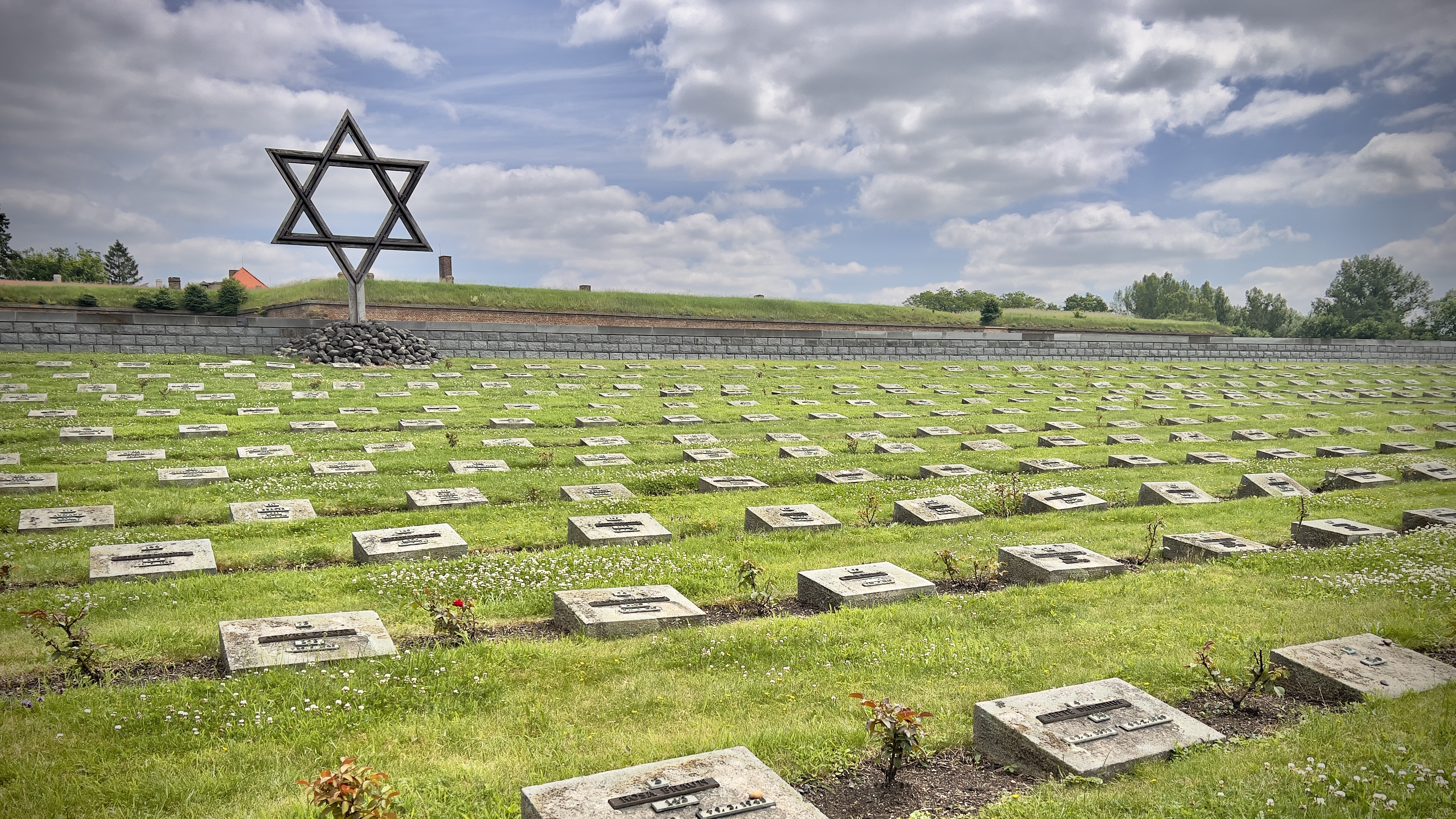
In the Czech Republic, Terezin sits as a living testament to the horrors of history. A visit to the Terezin memorial is not just a journey through history, but an important pilgrimage. The former World War II Terezin concentration camp stands as a solemn reminder, drawing visitors from around the world to this small Czech Republic town. Between 1941 and 1945, 190,000 Jews passed through this town often in transit to extermination camps; tens of thousands of others died in Terezin from disease. Although you may not have heard of this Prague concentration camp, you should.
Don’t let travel planning overwhelm keep you from experiencing these important Prague World War 2 sites; this Czech Republic concentration camp will change how you view history. Here are the travel details you need from this travel mom to help you prepare to explore this hauntingly beautiful site and reflect on the history lessons it has to offer. Save this Terezin post, and let me know if you have any questions!
~~~> Hey! I think you might be overwhelmed with lots of Terezin questions; I know I definitely didn’t know what to expect. If you’re a concerned parent, jump down to “Can I Take Kids to Terezin?” . This is an important site that you won’t regret visiting.

What is Terezin?
The small town of Terezín holds a heavy legacy. Visiting Terezin town includes various locations: the small fortress which is the Terezin Memorial (east of the Terezin walls), the walled town of Terezin which became the Jewish ghetto, and the Terezin crematorium and cemetery (south of the Terezin walls).
Known primarily for its role during World War II as a ghetto and concentration camp, Terezín is a place where human suffering and resistance intertwine. It stands as a solemn reminder of the atrocities committed during the Holocaust, while also serving as a testament to the strength and resilience of those who endured its horrors in the prison and inside the walls of the Terezin Ghetto. For me, one of the most interesting parts was learning about the Terezin propaganda film (watch the Terezin movie here).
The history of this site dates back to the last 18th century when it was built as a fortress town by Hapsburg Emperor Joseph II to defend the borders of Bohemia from attacks. Named after the emperor’s mother, Empress Theresa, you may see Terezin labeled as Theresienstadt on Holocaust and World War 2 maps. During World War 1, it became famous as the prison for Austro-Hungarian opponents including Gavrilo Principe who helped start World War 1 when he assassinated Archduke Franz Ferdinand. (Look for the plaques above his tiny cell while visiting the Small Fortress.)
Today, Terezin town is a small restored town of less than 3,000 inhabitants. Although it depends mostly on tourism, it’s far from a “tourist trap”. Yes, you will see tourists, but the sites are spread out and probably won’t feel crowded. There are several local restaurants and small shops where they will be able to speak limited English, but you can most likely communicate as needed.
~~~> Wanting to start with some US Holocaust Museums? Check out this post with info about the St. Petersburg, Florida Holocaust Museum. I also highly recommend the Houston Holocaust Museum and the Breman Jewish Heritage and Holocaust Museum in Atlanta.

Where is Terezin Located?
The Terezin concentration camp is the only Holocaust concentration camp near Prague. Only about forty miles (60 kilometers) north of Praguein the Czech Republic, don’t let the Prague to Terezin distance keep you from visiting. It’s a quick one hour trip through the lovely countryside of Czech and a good way to get out of the busy city of Prague. If you have several days on your Czech trip to visit Prague, make sure to save one of them a day trip to Terezin.

Why Should I Visit Terezin?
To me, travel isn’t just about seeing the places and checking off your bucket list. Yes, do the fun stuff, but also do the important. See the places that will change your view of people, history, and yourself. Terezin Concentration Camp is one of those places. The kids and I have read all the WW2 books, visited Holocaust Museums, talked about WW2 in detail… but none of that compares to visiting one in read life.
When you travel from Prague to Terezin you’re making a choice to see and talk about real history. You will see just a normal looking place and a beautiful little town. Without the history behind it and the stories, you could miss why it’s important. This is homeschool travel at its finest; history comes off the pages. Experience the truth. And be changed. It’s the place you’ve never heard of… and the place you’ll never forget.
(Yes, I know that sounds like sap, but it’s true. I will never look at a World War 2 book or hear the word “ghetto” without thinking back to our day walking the streets of Terezin. It changes you. But that’s what good travel should do.)

How Do I Get to Terezín Camp?
Terezín is a convenient day trip from the Czech capital of Prague. The town is easily accessible, so you can choose the mode of transportation that works best for your itinerary. The easiest way to route during our visit was to let your Apple Maps tell you exactly when the busses are leaving and give you directions around the town of Terezin. If you’re traveling without a Czech speaker, plan to use your phone GPS; from our experience, the bus and train operators will only speak limited English.
By Bus: You can catch a direct Terezin bus from Prague’s Černý Most bus station. This straight ride takes about an hour. To start your visit at the Small Fortress, exit the bus at the “Terezín, U pámátníku” stop. To continue to the Ghetto Museum within the walls of Terezin, exit at “Terezín, Autobusové nádraží”.

By Train: The official Terezin website says there is no direct train route to Terezin as you will have to continue by bus. Nearest train stops in Bohušovice nad Ohří and Litoměřice.
By Car: The drive from Prague takes about 45 minutes via the D8 highway. If you’re renting a car or taking a taxi, you’ll find parking available at the Small Fortress, Terezin city Information Center, or at the Crematorium. Of note, if driving, I would drive from the Fortress as it is quite a walk back to the Fortress from the Crematorium.
By Bike: If you arrive by bike, you will need to park your bike outside the Small Fortress. You are allowed to ride them around the town and out to the crematorium site.

Terezín Memorial: Key Sites to Visit
The Terezín Memorial complex is spread across several locations, each shedding light on different aspects of the ghetto’s history and its role in the Holocaust. Here are the key sites you should visit when touring Terezín:
1. The Terezin Fortress (Malá pevnost)
A good first stop is the Terezin Small Fortress located just outside the town of Terezín. This is an unforgettable experience. Enter the prison cells and grounds, see where the officers and their families lived nearby, and hear the stories. The memorial’s exhibitions located in the officer’s section of the fortress document the harsh conditions of the prison and the stories of the men and women who were tortured here. Take time to watch the Terezin film in the museum.

Unlike the town of Terezin which imprisoned most of the Jewish people, the Small Fortress was used by the Gestapo as a prison and interrogation center. Thirty thousand prisoners, including political dissidents, Nazi resistance fighters, and Jews, were held here, often subjected to torture and death. This was also used as a transition place before prisoners were sent on to concentration and death camp like Auschwitz. Post-war, this fortress served as an internment camp for Germans.

2. The Terezin Ghetto Museum
The Ghetto Museum is located within the walls of Terezín in the former Jewish School and School Building. It’s a good starting point for your visit, offering a comprehensive overview of the history of Terezín as a concentration camp and ghetto. Plan to spend at least an hour here.
Here, you’ll find historical documents, photographs, and survivor testimonies that tell the story of the thousands of Jews imprisoned here, many of whom were eventually deported to death camps. The museum’s exhibits include a collection of Terezin art and poetry created by the prisoners, especially the children, which serves as a testimony to the creativity and resilience that persisted even under the most brutal conditions.
Here you can also view a video discussing how the Terezin ghetto was beautified for the Red Cross visit. While the Terezin propaganda videos are available online, this talks about it in more detail. It makes your upcoming walk around the town even more significant in contrast.

3. The Town of Terezin
As you approach the walls of Terezin from the direction of the Small Fortress, admire the baroque walls. They are an architectural feat. Make sure you stop as you cross the Ohre River. Not only does it provide additional separation and protection for the fort, but at the crematorium, you will read about the thousands of remains which were disposed of here in the river at the end of the war. There is a plaque as you cross the river commemorating this site.
With 90% of the town still intact, a day walking the streets of Terezin allows you to appreciate the buildings and just imagine life “back then”. To fully appreciate the fortress town, check out this picture of Terezin from above that lets you appreciate the star-shape.

4. The Terezin Crematorium and Colobarium
Another crucial part of Terezín’s history is at the end of the train tracks outside the city. Stop at the city walls the visit tithe columbarium where they are niches which held the urns containing ashes. Inmates expected that these would be buried after the war ended; this didn’t happen. As many as 22,000 urns were emptied into the Orhe River; only a small porter were buried. Take some time to explore the tunnels in the walls which lead to a preparation area and funeral area.
The crematorium, used during the war to dispose of the bodies of those who died in the ghetto. The crematorium building itself is a sobering reminder of the death toll and the cruel fate of many Terezín residents. There is a small museum at the crematorium with signs detailing the atrocities. You will even see the incinerators and the doctor rooms.

5. The Terezin Cemetery
Terezin has two cemeteries. The National Cemetery, located near the Small Fortress, serves as a final resting place for thousands of prisoners who perished due to starvation, disease, and exhaustion. You can visit the monument in the cemetery, where the names of victims are etched in stone, and take a moment to reflect on the enormity of the loss.
6. The Ghetto Memorial and Memorial Wall
Located within the town of Terezín, this memorial honors the victims of the ghetto and the many deported to death camps. The Memorial Wall, which displays the names of thousands of Jews who were deported from Terezín, offers a place for reflection and remembrance. It’s a powerful way to connect the faces of the victims to the physical space, grounding the statistics and dates in the personal history of those who lived and died here.

7. Madgeburg Barracks in Terezin
The Madgeburg Barracks is now a Terezin museum located in the former army barracks. It houses a replica prison dormitory as well as several exhibits about art and music during life in the Terezin ghetto. (We were unable to visit this, but it sounds like we should have!)
Planning for the Day
How Do I Get Terezin Tickets?
Terezin Concentration Camp tickets can be bought the day of your trip unless you want a tour. If you plan on a self-guided tour of the Terezin sites, you do not need a reservation, and you can simply buy tickets at the entrance upon arrival. You do not need a ticket to visit the town or crematorium as they are open to the public. Make sure you read my thoughts about a self-guided visit to Terezin.
Are There Guided Terezin Tours?
Many visitors find it helpful to use an audio guide or to take a guided Terezin tour to fully understand the context of what they are seeing at the Memorial. If you are wanting a tour of Terezin, please check the Terezin Memorial reservation website. The Terezín Memorial offers both guided tours in several languages, which will provide deeper insights into the history of the site. You can also join a tour when you arrive, but there is no guarantee of availability. Tours are available in several different languages at different times.
Audio guides are also available in various languages for a more self-directed visit. There is also a book guide available at the on-site Terezin bookstore.

Can I See Terezin without a Tour Guide?
You do not need a tour guide to visit the Terezin Memorial, town, or crematorium. However, if you are visiting the fortress and memorial without a guide, try to start at the museum inside the fortress or the Ghetto Museum, so you have a better background of what you will be seeing.
There is plenty of signage in English at the Ghetto Museum and Crematorium. Unfortunately, the signs at the small fortress and memorial are scarce. If visiting with sensitive people or children, it might be best to do it without a guide in order to skip the more upsetting portions and descriptions.

Touring Terezín: What to Expect
Visiting Terezín is an emotionally intense experience, and it’s important to approach the site with respect and mindfulness. Here are some tips to ensure your Terezin visit is meaningful and impactful:
Be prepared for the emotional toll: Visiting Terezín can be emotionally challenging. The exhibits are often stark, and many of the photographs and artifacts will stay with you long after the visit. It’s normal to feel moved, and it’s important to take breaks if needed. The Terezín Memorial offers some outdoor spaces where you can sit and process what you’ve seen.
Reflect and respect: Terezín is a place of deep sorrow and remembrance. Visitors are encouraged to be quiet and respectful, especially in the cemetery and crematorium areas. Take time to think about the stories shared throughout the exhibits and honor the lives of those who perished here.
Prepare and Learn Before the Visit: Like so many other visited historical sites, there is a lot to be said with being familiar with the place beforehand. On this Terezin trip, we knew nothing about the specific town of Terezin or the fortress. Through previous books, museum trips, and homeschool learning, the kids know a lot about World War 2 history and the Holocaust. However, we did spend quite a bit of time looking up extra information during our day; good thing we had data on our cell phones!

Terezin FAQs
Are there restrooms at Terezin?
There is a restroom you can use inside the Terezin fortress. However, if you walk around town or toward the crematorium, you probably won’t find one. Best bet is to eat lunch in the town or head to the Ghetto Museum for a restroom break before walking out or heading to the bus stop.
How Do I Get from the Small Fortress into Terezin?
Getting to the different areas of Terezin, is best done by food, and the small fortress to the town is only a walk of maybe ten minutes. You will get off the bus and head one direction to the Fortress to turn around the other direction toward the town. It’s about a another fifteen minutes from the downtown to the Terezin Crematorium.
How Do I Get Around Terezin Town?
The town of Terezin is less than six square miles; plan to walk. While some of the Czech bus routes stop at different locations within town, the town is so small that you can walk from one end to the other in about fifteen minutes. A sleepy little town, there are hardly any cars in town, but they are allowed.

How Long Do I Need to Visit Terezin?
Allow at least 4-5 hours to visit the fort and the town. While you can see the key sites in a few hours, Terezín deserves more time. Be prepared to take your time in the exhibits at the fortress and in the concentration camp area. Read the stories and take time to discuss with the family. There’s a lot to take in, both visually and emotionally. Not to mention, Terezin itself is a small town with snacks and restaurants and beautiful buildings. Leave time to wander and just soak it all in.
When is the Best Time of Year to Visit Terezin?
While Terezín is open year-round, the best time to visit is during the spring or fall months when the weather is mild, and the crowds are smaller. Summer, especially in July and August, tends to be busier, as it’s a popular destination for both international tourists and school groups. The off-season, however, allows for a quieter, more reflective experience. Click here to check the hours of operation at Terezin Memorial.

Is Terezin Good for Kids?
If you have children who are old enough to understand the significance of World War 2 and the Holocaust, then Terezin is absolutely a good Prague day trip with learning benefits. Many concentration camps do not allow young kids, so for that reason, Terezin may be your best option.
While there are obviously some difficult topics, there isn’t anything posted that is overly graphic. As you will be wandering through the entire camp and town, there is plenty of room for moms with strollers or little kids who need to get some energy out. Obviously, they need to be old enough to understand the gravity of the situation.
Check Out These Related Posts

Thanks for stopping by my little corner! Here’s to your next adventure.
I’m Bobbie. As transplants from Texas, my family of six is on a mission to discover all of Georgia’s amazing places, experience amazing road trips across the United States, and create a homeschool life along the way.
Want to adventure like me? Reach out! I’d love to chat. Stop by my Instagram or Pinterest page to discover more of our adventures.
Want to work with me? I’d love to work with your destination and tourism board to help other family travelers see all you have to offer.
Thanks for stopping by my little corner! Here’s to your next adventure.
I’m Bobbie. As transplants from Texas, my family of six is on a mission to discover all of Georgia’s amazing places, experience amazing road trips across the United States, and create a homeschool life along the way.
Want to adventure like me? Reach out! I’d love to chat. Stop by my Instagram or Pinterest page to discover more of our adventures.
Want to work with me? I’d love to work with your destination and tourism board to help other family travelers see all you have to offer.
Leave a Reply