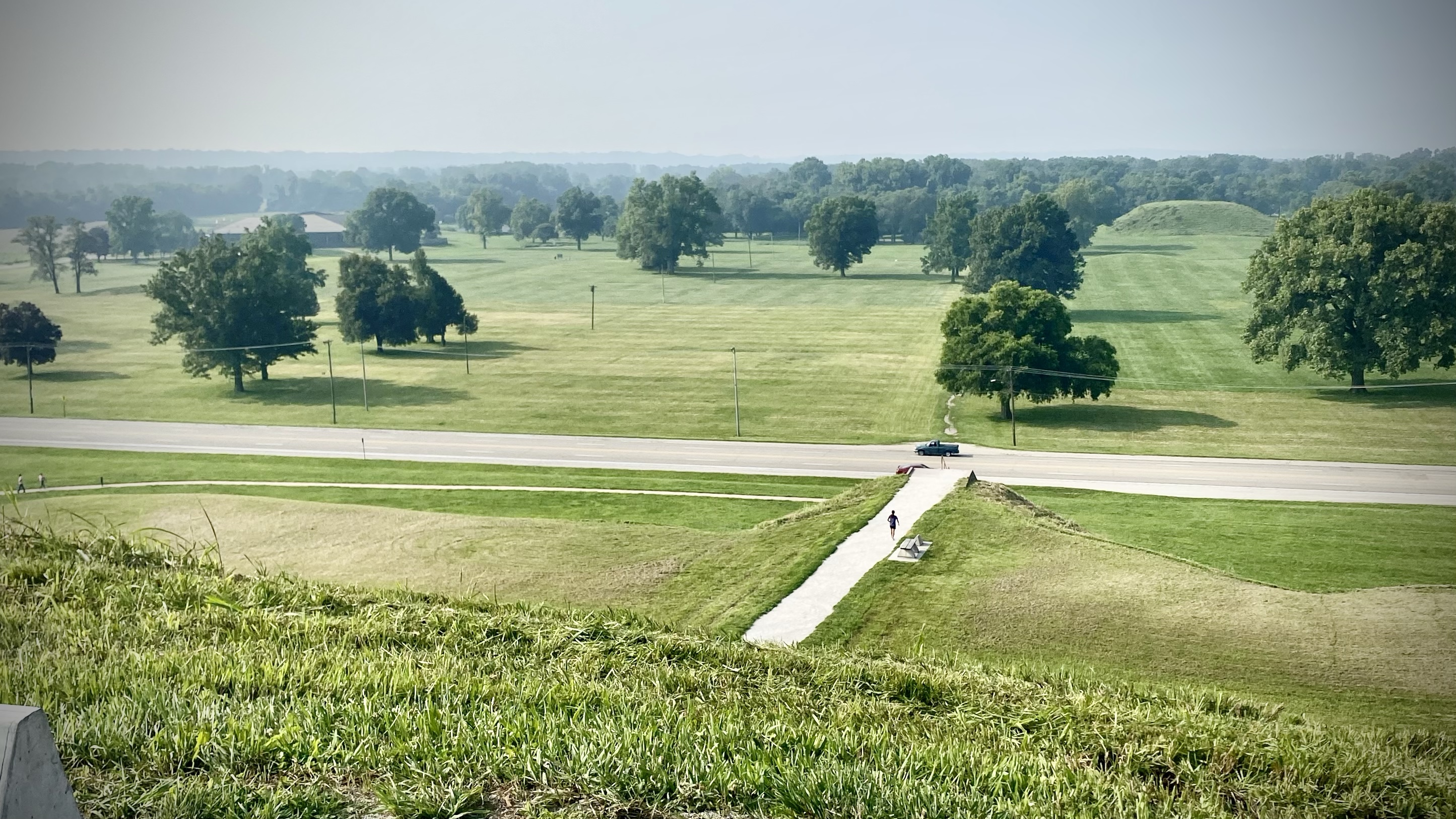
Did you know the largest ancient settlement north of Mexico, Cahokia Mounds, is just 15 minutes from St. Louis? Despite its significance and recognition as a UNESCO World Heritage Site, many people don’t even know Cahokia Mounds exists.
I admit that I didn’t learn about ancient mound-building civilizations in the US until I started homeschooling and discovered places like Emerald Mound in Mississippi. These Native American history spots sparked my curiosity, and soon I noticed signs for mounds across the Southeast. When I found out our trip to St. Louis would take us near Cahokia Mounds, it was immediately on the Missouri road trip list.
Here are all my travel mom Cahokia Mounds top tips. Share this place with others, and let’s make sure more people know about this incredible historic site!

Affiliate disclosure: When you click and purchase a link in my post, I may earn an affiliate commission at no extra cost to you. I promise to only recommend products or places that I have personally want, used, or researched. Thanks in advance for the gallon of gas. 😉
Who Were Mound Builders?
Beginning in 500 BC while the Ancient Greeks were building their temples, these mound building Americans were spreading across the eastern United States until 1650 AD. Ranging from the Great Lakes region down the Mississippi Valley into the Gulf of Mexico, the practice of mound building spread over two centuries as the villages scattered. Three of the largest mound building peoples were the Adena, Hopewell, and Missisippians. While some mounds were used as burial sites, the largest were the elevated location for the temple. Some sites have effigies of animals whose purpose is still being questioned.
At more than 2000 acres in size, this city of the Mississippians had an estimated population of up to 20,000 during the 14th century which makes it more populous than London at the same time. By carrying soil in baskets on their backs, they built more than 120 earthen mounds in this city made of earth. The city of Cahokia near the banks of the Mississippi River was inhabited from 700 to 1400 AD. The population is thought to have expanded up to 20,000 people at it’s peak between 1050 and 1150 AD, but began declining in 1400. The native population disappeared at least 300 years before the arrival of Lewis and Clark in the late 1800s, and there is no actual documentation that anyone from their group visited this site. The reason for the disappearance of this entire people group is still speculated today.

Why Should We Visit Cahokia?
In 1982, UNESCO designated Cahokia Mounds as a World Heritage Site – the United States only has 24, so that makes them even more important! To be a World Heritage Site means that a national committee decided that this specific place was significance to humanity and the world. If it’s important tot he whole world, it sure should be to you either. Monks Mound is the largest man-built Native American mound in the United States. We should be teaching our kids our country’s own oldest history!

FAQ About Cahokia Mounds
Hours Currently, the Interpretive Center is open Thursday to Sunday from 9-5. The grounds are open daily from dawn to dusk. If you’re just driving, don’t hesitate just to stop because the Center is closed. You will have full access to the rest of the grounds with informative plaques along the way. There are public tours available Thursday to Sunday at 10 and 2 lasting about an hour.
Location: 8 miles east from downtown St. Louis across the Mississippi River on I-55.
Cost: Cahokia is Free! There is no admission fee to the interpretive center but there is a recommended faily donation of $15 for families.
How Long Do I need? Allow at least 2-3 hours to explore including inside and hiking Monks Mound. This could be a full day event with the museum galleries and many outside trails.

What is at Cahokia Mounds?
Visitor Center
Museum Displays – Explore the exhibits and the artifacts uncovered during the different stages of excavation. Learn about their interactions with surrounding mound building civilizations and Native American tribes. See how their jobs and food sources changed with the seasons. Learn about their culture including burial practices as uncovered in the mounds. There is so much to see here we ran out of time to explore it all.
City Exhibit – Start with the centralized village exhibit to see the overall view of the land. Using this, you will be able to see the extent of the fences, pick out mounds you might have overlooked, and see the scale of the village. Although hard to see in person, this allows to see the three different mound shapes. Head out from here to the back porch to look out over the other mounds. There are also several trails from which you can explore some of the smaller mounds on this side of the highway.
Reproduction Village – For my family, our favorite area of the visitor center was the large glass-surrounded reproduction of village life in the center of the exhibit area. Walk around the outside to see the details which continue inside including prepping and using the sweat lodge. These glimpses of daily life show kids being kids, moms taking care of the cooking, men preparing the game, and the housing structures.

Archeology – The archeology here isn’t just the artifacts scattered throughout the museum. Don’t leave without going to the archeology portion complete with video of the excavation and a simulated archeological site. We’ve been to many museums, and I can honestly say this is the best archeology information center I’ve seen. My little archeologist loved hanging out in this area.
Video – Make sure to ask about the time for the short video; it was slightly dated but worth our 15 minutes.
Monks Mound
This largest earthwork in North America is located down the road from Woodhenge on the opposite side from the Visitor Center with a separate parking lot. Make sure to read the interpretive sign before heading to the trail. At more than 100 feet tall, prepare yourself to hike up the 165 steps and bring some water. There is a handrail in the middle of the steps, but this could be nerve-wracking for parents with little kids.
Use this high elevation to look out over the grounds and search for the different mounds in the distance. With a clear sky, you can look west to see the St. Louis Arch.
Off the far end of the parking lot are examples of the palisade which at one time surrounded the entirety of the community. This small rebuilt section is the only area where you can appreciate how tall these logs were.

Woodhenge
This reconstructed ancient sun calendar was named after Stonehenge due to its circular shape, large poles, and ability to mark the equinoxes as the sun’s location changes with the seasons. As the farthest site west in this area to explore, you can easily make this your first stop as you drive east from St. Louis. The parking lot has a large sign discussing the various stages of reconstruction and its significance.
The Grounds
The Cahokia Mounds covered 2,200 acres of the original site of which 800 are accessible to visitors. There are also self guided tours available for a small fee as well as a nature booklet to take you on a 5 mile hike through the more distant areas of the site. Get a map at the information desk inside the interpretive center. ? How many mounds can you visit?

Cahokia Mounds Travel Tips
Remember that, for some people, this is a sacred site. Take the time to discuss with your kids what places in their faith they might consider sacred and how they should act there. Additionally, these sites are thousands of years old. Keep the kids on the path and tell them why.
- Wear proper shoes to be prepared to hike to the top of Monks Mound
- Don’t forget the bug spray.
- Bring a picnic to the picnic tables west of the Interpretive Center but leave your snacks in the car until picnic time as they are not allowed in the Center.
- Head to the website and explore the learning section.
- Bathroom are available in the visitor center. Don’t expect to find some outside.
- There are vending machines at the Interpretive Center.
- Water bottles are okay when walking around outside.
Warning: These native people are portrayed as they lived. There will be female figures wearing only a skirt and males with loin cloths. Take the time before the visit to prepare your kids for appropriate reactions.

Adult Learning About the People of Cahokia
Podcasts
- History Unplugged – July 28, 2020 “In 1200 AD, this Indian city….”
- Stuff They Don’t Want You to Know – March 29, 2019 “How did North America’s largest city disappear? The Mysterious Collapse of Cahokia”
Adult Books
Disclaimer, I haven’t gotten around to reading these yet!
- People of the Morning Star – W. Michael Gear and Kathleen O’Neal Gear. Five book series about the Cahokia people written by two archeologists.
- Cahokia Mounds: America’s First City (Landmarks) – William Isemenger (2010). This appears to be a non-fiction history book.

How Can Kids Learn More About Cahokia?
Kid Books
If you find some good books about Cahokia or mound builders, please let me know! I have only located a few and none easily accessible.
Deep Dives
- How does this time period compare to what was happening with Mayas, Incas, and Aztecs? What are the similarities and differences?
- What do you think might have happened to the civilization?
- Look at the location and geography on the map. Why do you think this would have been an ideal area to settle?
- What materials did they use to construct the palisade, mounds, and homes? How would that have affected the land?
- How were their lives similar and different to yours today?
- How do the Mound Builders live differently than other Native American tribes you have studied?
- Why do you think more people don’t visit here?

What are Other Mound Building Sites?
There are so many mound building sites to visit and explore with your families. While a few have been designated national parks, some are lesser known state parks. I have not been able to find a complete site to list all possible locations. Don’t forget to spend several days in St. Louis before leaving the area or explore along the Great River Road as you drive along the Mississippi River.
The specific sites listed below are ones that our family has personally visited, but I promise, none are as impressive as the Cahokia Mounds.
Etowah Indian Mounds State Historic Park – Cartersville, GA
Located just north of Atlanta, most of your time visiting Etowah Indian Mounds will be spent outside exploring the six earthen mounds, the borrow sites, and the nearby Etowah River. There is a small museum with a short video and exhibits. Plan to linger along the trails. Don’t forget the picnic to eat after your adventure at the picnic tables behind the visitor center.

Ocmulgee Mounds National Historic Site – Macon, Georgia
With miles of trails to explore, the highlight of this Ocmulgee National Historic Site is the Great Temple Mound. Grab a Junior Ranger booklet for your kids, watch the video in the Visitor Center, and explore the excellent museum. If you live in the area, plan to attend the yearly Native American celebration days.
Grand Village of the Natchez Indians – Natchez, Mississippi
In Natchez, Mississippi, the Grand Village of the Natchez Indians is smaller park with only three mounds to discover, the nature trail will also take you to a reconstructed Natchez Indian house. Don’t overlook the small museum showcasing artifacts from the area. There are many other mound sites in this area to visit!
Go see some ancient history right in the middle of the United States! You’ve seen the St. Louis Arch. Don’t skip out on one of the best places to visit in the area.

Thanks for stopping by my little corner! Here’s to your next adventure.
I’m Bobbie. As transplants from Texas, my family of six is on a mission to discover all of Georgia’s amazing places, experience amazing road trips across the United States, and create a homeschool life along the way.
Want to adventure like me? Reach out! I’d love to chat. Stop by my Instagram or Pinterest page to discover more of our adventures.
Want to work with me? I’d love to work with your destination and tourism board to help other family travelers see all you have to offer.
Leave a Reply