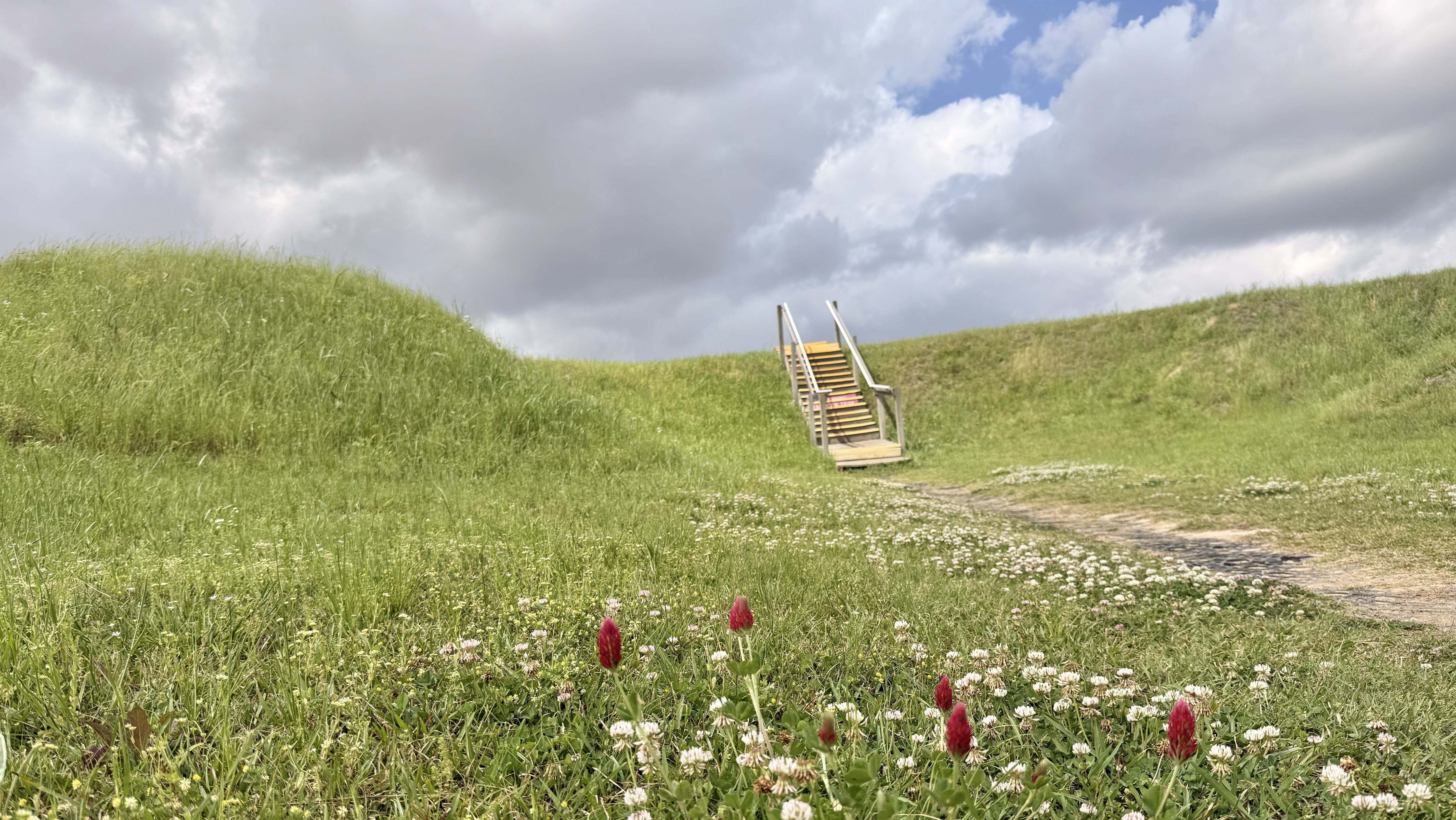
Poverty Point World Heritage Site is the Louisiana historical site that you need to add to your southern road trip, and you probably haven’t heard of it! This UNESCO World Heritage Site is home to some of the oldest and largest prehistoric earthworks in North America, built over 3,000 years ago. Long before European explorers landed or even before Christ, Louisiana’s Poverty Point was the biggest city of a large Indigenous civilization.

Also designated Poverty Point National Monument and Poverty Point National Historic Landmark, this Louisiana historic site has all the names to convince you of it’s importance. These Native American mounds may not look like much at first glance, but once you understand their importance and the mound builders, it completely changes how you see early American history.
Quick Jump to Poverty Point Questions
- Where Is Poverty Point Located?
- What Is Poverty Point? (And Why It Matters)
- What are the Poverty Point Sights
- What is the Best Way to Visit Poverty Point?
- Poverty Point Visitor Center
- How Much Time Will I to Spend at Poverty Point?
- Visiting Poverty Point with Kids
- Other Mound Sites Near Poverty Point
Affiliate disclosure: When you click and purchase a link in my post, I may earn an (small) affiliate commission on products, services, or travel bookings at no extra cost to you. If you want to help support this website, you need to accept the cookie pop-up for the link to be credited back to the site. Thanks in advance for the gallon of gas. 😉

Where Is Poverty Point Located?
Poverty Point sits in a quiet stretch of northeastern Louisiana, just outside the small town of Epps and about twenty minutes north of I-20. We stayed at a hotel in Vicksburg and drove an hour and twenty minutes to Poverty Point in the morning. It was just a quick detour from our drive from Georgia through Dallas and to Wichita Falls. Yet, I had never stopped!
Poverty Point is not a place you stumble upon accidentally. You’ll drive past farmland, open fields, and long rural roads before you arrive; it is very much out in the country. Don’t be like me and forget to get gas before leaving the highway!
The closest large city is Monroe, about 45 minutes away. If you’re driving across the I20 corridor, Vicksburg (another important history stop!) is just over an hour east. I didn’t even see signs pointing to it until we were about five minutes away. This is why you’ve been close many times, and you didn’t know what you were missing!
Although you have to plan for this UNESCO site, Poverty Point should be on your list. THe distance from major tourist areas is exactly what keeps it peaceful, uncrowded, and memorable. Also the low crowds mean it’s been kept intact compared to the busier sites like Ocmulgee in Georgia and Cahokia Mounds in Illinois (read my post here).

What Is Poverty Point? (And Why Does It Matter?)
Growing up in Wichita Falls in North Texas, I learned mostly about the Plains Indians. Teepees and packing up camp to follow the buffalo herds like Dances with Wolves. It wasn’t until I was homeschooling my own children with Classical Conversations that I even knew about the mound building civilizations of North America! Shame on me.
At a time when most societies in North America were small and mobile, Poverty Point functioned as a large central location for trade, gathering, and daily life. Poverty Point artifacts show connections to materials from across the continent, suggesting a wide and organized trade network. This wasn’t a primitive group of people – it was connected and complex.

When Was Poverty Point Built?
Poverty Point is one of the most important prehistoric sites in North America. Built between roughly 1700 and 1100 BC, it was not a simple Native American settlement. This community includes a massive, planned earthwork complex created by hunter-gatherers who moved enormous amounts of soil by hand. Although we aren’t 100% sure of the original purpose of the large ridges, the evidence still exists 3000 years later.

What to See at Poverty Point: Mounds, Ridges, and the Plaza
One of the biggest challenges when visiting Poverty Point is understanding how the site is laid out from your ground-level viewpoint. The most defining Poverty Point feature is a series of six stacked large, semi-circular ridges stacked across hundreds of acres. In person, as you drive or walk, you can visualize the ridges where the grass is allowed to grow taller to help you visualize. Over the millenia, erosion has made the ridges less visible, but their size is still amazing.
Archeological evidence tells that these ridges were wide enough for homes to sit on top of the ridges. These semi-circles overlooked a massive, flat central plaza. The 37-acre open-space plaza was likely used for gatherings, trade, and ceremonial activities. Sitting several feet higher than the original ground level, this flat gathering area was raised up several feet by the inhabitants. Imagine the dedication and number of people required to haul that much dirt!

Orient yourself by looking out from the visitor center parking lot where you can see Poverty Point’s highest mound. Mound A, which rises about 72 feet above the surrounding landscape, is one of the largest earthen mounds in North America. Visitors can climb stairs to the top of Mound A for a view across the entire site. From there, the ridges and layout begin to come into focus. You can walk to Mound A from the visitor center, take a guided tram ride, or drive yourself over.
The other mounds, including Mound B, C, and D, are spread throughout the site and reflect different stages of construction and use. Together, they show that Poverty Point was not built all at once but developed over generations. Unlike other Native American sites, these are not Native American burial mounds.

How to Visit Poverty Point
Starting your trip at the Poverty Point visitor center, and discuss your options with the helpful staff. Many visitors drive the one-direction loop, which allows you to move at your own pace. This self-guided option works especially well for families or anyone short on time; it can be easily completed in about thirty minutes.
For a deeper understanding of Poverty Point history, the guided tram tour is worth it. Led by site staff, it provides context that connects the landscape to the people who built it. For first-time visitors, this makes the experience more meaningful. Upon arrival, see if the inexpensive tickets are still available at the Visitor Center. As the only guests at the Visitor Center during our Poverty Point trip, we were lucky to get a personalized tour on a golf cart; however, this isn’t the norm.
If you want to make a longer visit and walk the one-mile Poverty Point trail around the mounds, pick up a map at the Visitor Center. This hike will take you to the mounds and around the plaza for the best way to really see the ridges that are difficult to see from the tram. If you’re hiking the mounds, prepare for stairs and wear good shoes!

Poverty Point Visitor Center
Before heading out, it’s worth spending time in the visitor center. A short introductory film gives helpful context, and the exhibits explain how the site was built and what daily life may have looked like. Artifacts from across the trade network are on display, helping you see how connected this place once was with other groups of people even as far away as Florida.
My favorite display in the Poverty Point Visitor Center was the timeline comparing the age of Poverty Point to that of other well-known ancient sites around the world. This US UNESCO site was already ancient by the time many of the world’s most famous historic sites were built. It predates places like the Roman Colosseum and Chichen Itza by thousands of years!
Take the time to check out the Bayou Maçon behind the center. This small river was the main source of transportation for people traveling from a distance. One of the earthen structures is located right on the river and lines right up with the view of Mound A. Imagine stepping out of your simple boat to see the largest manmade structure you had ever seen; you know you’d have been impressed.

FAQ: Visiting Poverty Point
Is Poverty Point worth visiting with kids?
Poverty Point works well for families because it offers something many historic sites do not – space. Kids can move, explore, and climb rather than simply observe. Additionally, the museum is small with enclosed artifacts. There is no worry about bumping into and breaking something. All kids are fascinated by arrowheads!
The openness of the site makes it easier to engage different ages, and the ability to stand on top of Mound A often becomes the highlight of the visit. Even the most history-averse kids will enjoy the tram ride. Picnic tables are available at the visitor center, making it a practical stop for groups or road trips.

When is the Best Time to Visit Poverty Point?
The best time to visit Poverty Point is during the cooler months, especially fall, winter, and early spring. Because the site is largely open with very little shade, summer visits can be hot and intense, particularly in the middle of the day.
If you are visiting in warmer months, go early in the morning or late in the afternoon. Mild temperatures make it much easier to walk the ridges, climb Mound A, and spend time exploring without feeling rushed.
How long do you need at Poverty Point?
Most visitors spend between two and three hours exploring the site. If you are short on time, you can see the highlights in about an hour and a half. If you include the visitor center, time to walk the ridges, and possibly a tram tour, this easily becomes a half-day experience.
However, if you just want a quick look. Use the free bathroom, pay the minimal museum fee, watch the videos, and do an hour of learning. It’s better than nothin!

Should you take the tram tour or drive?
Both options work well, but they offer different experiences. Driving the loop gives flexibility and works well for families or tighter schedules. The tram tour provides context and storytelling that help connect what you are seeing to the bigger picture, making it especially valuable for first-time visitors.
How many visitors come to Poverty Point yearly?
Despite its age and importance in US history, Poverty Point remains one of the least crowded UNESCO World Heritage Sites in the United States, with around 15,000 visitors per year. This low number means you can explore at your own pace without crowds, noise, or long waits. It’s a very different experience from most major historic destinations.

What should you wear when visiting Poverty Point?
This is an outdoor site with large open spaces, so comfortable walking shoes are important. Expect uneven ground, grassy areas, and very little shade. In warmer months, lightweight clothing and sun protection make a big difference. There were quite a few little bugs buzzing around during our trip, so bug spray is a good idea.
Are there places to eat at Poverty Point?
There are no major food options on-site, so it is best to plan ahead. Many visitors bring snacks or pack a picnic, especially since there are picnic tables available and plenty of space to sit and take a break. The surrounding area is rural, so nearby restaurant options are limited.
Is Poverty Point crowded?
No, Poverty Point is one of the least crowded major historic sites in the United States. With around 15,000 visitors per year, it often feels quiet and open, allowing you to explore without distraction.

My Poverty Point Review
Poverty Point is easy to underestimate. There are no towering ruins or dramatic structures—just earth, grass, and space. But once you understand what was built here, without modern tools or machines, it begins to feel different.
Not empty. But intentional. And like many places worth visiting, it rewards those who are willing to slow down and pay attention.
Mound Sites Near Poverty Point
If you’re interested in exploring more ancient sites, there are a few worth noting in the same area as Poverty Point. The nearby Marsden Mounds in Louisiana offer a smaller but related example of mound-building cultures. The Jaketown Mounds in Mississippi connects to the broader Poverty Point trade network and helps expand the story beyond a single location.
Further away in the southern US, Native American sites like Cahokia Mounds in Missouri, Etowah Mounds in Georgia, and San Antonio Missions National Historical Park show how complex and organized communities developed across North America in different ways over time.
~~~> For an in-depth list of important ancient US history sites check out Epic Archeology Sites that Bring History to Life; save this comprehensive post and add other places to your family road trip.

My Favorite Travel Resources
- Booking.com – This is my go-to website for hotels, apartments, and even vacation home rentals to easily find places for my group of 6.
- Trip Advisor – This travel planning and booking website has been my go-to for decades. I especially use it to find nearby restaurants and activities.
- Viator – My go-to to find for city tours and experiences.
- Omio app and website – European train travel is easy for booking and keeping all tickets organized
- Radical Storage – Busy travel days sometimes means needing to leave your suitcase somewhere trustworthy. This worldwide option makes it easy.
- Welcome Pickups – I just found this company, but I plan to use them next time we need an airport or port transfer!

Thanks for stopping by my little corner! Here’s to your next adventure.
I’m Bobbie. After years of planning detailed family trips, I’m diving into travel advising. I’d love to take away the stress and plan a trip for you. Let’s get started today – click here to start.
You can count on me to share honest reviews and answer the questions you need to plan your own trip. My family of six is on a mission to discover all of Georgia’s amazing places, experience amazing road trips across the United States, and create a homeschool life along the way. We even world travel when we can!
Stop by my Instagram or Pinterest page to discover more of our adventures.
Leave a Reply