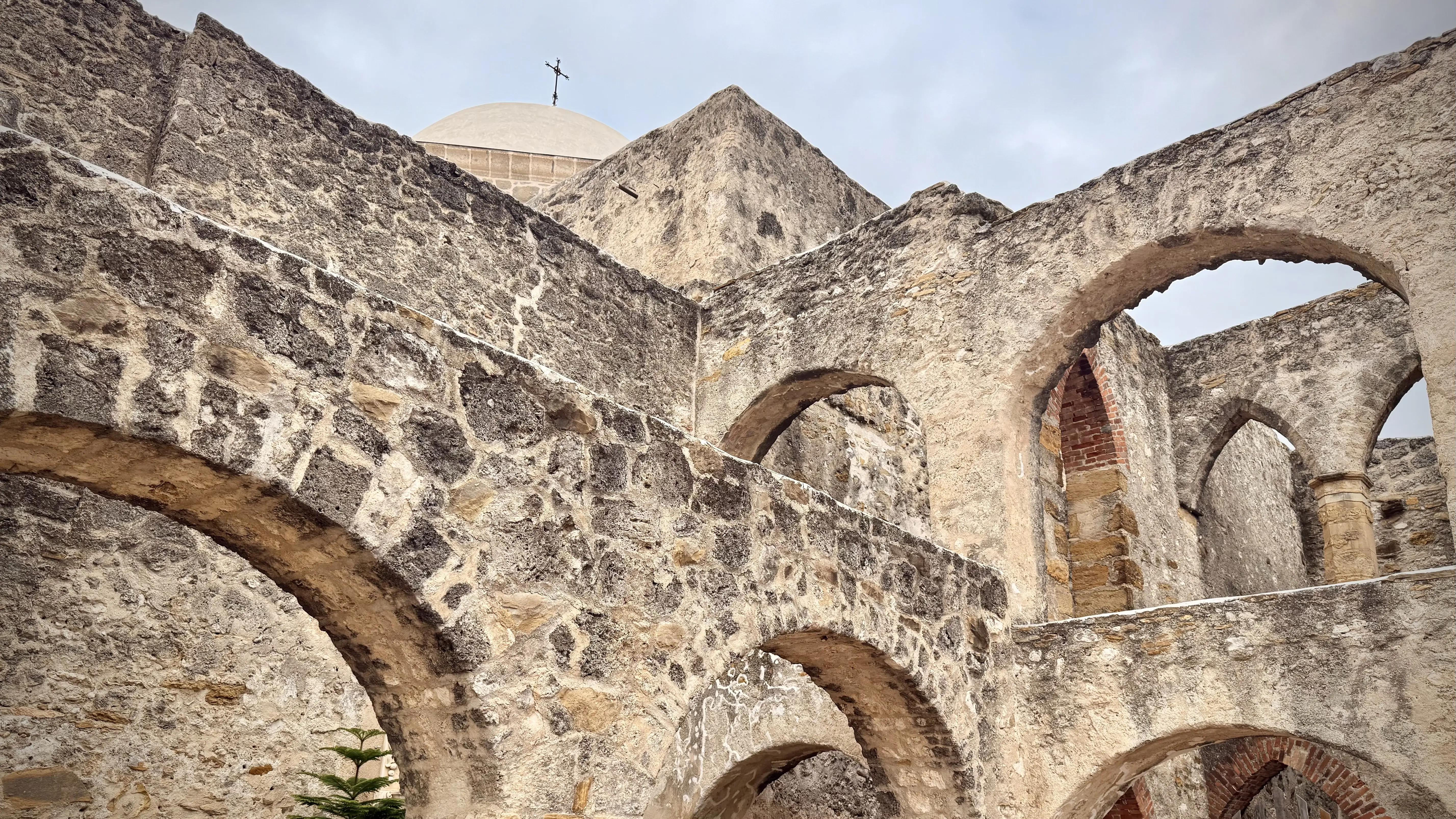
San Antonio Missions National Historic park is my favorite of the many San Antonio places to visit. Most families just see the Alamo when they visit San Antonio, but did you know San Antonio’s Alamo is only one of the four antique missions? Don’t just stay in old downtown San Antonio; just a few miles south is one of the most important historic sites in the United States.
The San Antonio Missions National Historical Park is a UNESCO World Heritage Site that includes four Spanish colonial missions connected by the scenic Mission Trail. Located three miles south of downtown, the whole site is completely free, easy to explore with kids, and far less crowded than downtown. This is a great stop for history trip or homeschool learning.

Wondering how to visit the San Antonio Missions during your Texas history road trip to San Antonio? Read this San Antonio travel guide to the missions, and you’ll be ready for your trip. Here’s everything you didn’t know you didn’t know. 🙂
San Antonio Missions Table of Contents
- The Story Behind the San Antonio Missions
- Best Order to Visit the San Antonio Missions
- How Long Does It Take to Visit the San Antonio Missions?
- Mission Concepción
- Mission San José
- Mission San Juan
- Mission Espada
- Espada Acequia
- San Fernando Cathedral
- World Heritage Center
- FAQ: Visiting the San Antonio Missions
- The Camino Connection: Texas to Spain
- The Pilgrimage Route
- San Fernando Cathedral (Final Stop)

History of the San Antonio Missions
The San Antonio Missions were established in the early 1700s by Spanish Franciscan missionaries as part of Spain’s expansion into Texas, which was at that time the northern frontier of New Spain.
These famous San Antonio churches were more than just churches. Together with the priests, these grew into entire communities where the Indigenous people lived within the mission walls for protection. In addition to teaching Christianity, the Spaniards also brought over farming, trades, and Spanish customs. Each mission included a stone church, living quarters, and farmland.

Together, these missions formed a connected network which followed along the San Antonio River – the San Antonio Mission Trail. Today, these missions are preserved by the National Park Service and remain active Catholic parishes. History today lives on through today’s traditions.
READ NEXT ~~~> If history spots are your travel goal, read this collection of history travel articles to help plan your next road family road trip.
Mission Concepción
Mission Concepción is the best-preserved original stone church in the United States. Unlike other missions, it has never been fully restored. What you see is close to the original 1700s building.
- Founded: 1716 (moved to current location in 1731)
- Best for: Seeing the most original mission structure
- Time needed: 20–30 minutes


Inside, faded color frescoes still line the walls of Mission Concepción, giving a glimpse into the color and beauty that once filled the space. It’s quiet, simple, and one of the most powerful stops for understanding the reality of mission life. Notice these architectural details!
Tucked just behind Mission Concepción, you’ll find the Margil Pilgrimage Center which serves as the headquarters for the local Camino route in San Antonio. Even if you aren’t doing the pilgrim trail, this is a great (and free) informative site to learn about the missions and it’s relationship to Spain’s Camino de Santiago.

Mission San José
Known as the “Queen of the Missions,” San José is the largest and most complete of the four. Mission San José is the heart of the San Antonio park – the place where you can best visualize what a mission looked like 300 years ago. This was the largest and most successful of the San Antonio missions, once home to hundreds of Indigenous residents within protective stone walls.
- Founded: 1720
- Best for: First-time visitors + families
- Time needed: 60–90 minutes

Begin your visit at the San Jose Visitor Center outside the walls is the main hub for this Texas National Park Service site. Inside, you’ll find exhibits that explain how the mission system worked with info on Indigenous life, Spanish colonization, farming, and the acequia irrigation system. There is a short film (Gente de Razón), maps, and artifacts to help connect the mission to the bigger Texas missions story. It’s also where you’ll find restrooms, a bookstore, and the National Park passport stamp, making it the best place to begin (or anchor) your visit.
Today, a visit to San José feels almost like entering a historic fort. Still surrounded by an intact stone wall, your eyes will be drawn to the church in the far corner and arches on the opposite side of the large courtyard. Here, you can walk through reconstructed living quarters and workshops built into the walls of the mission.

Ranger-guided tours are available daily at San José to help you understand more about mission life and the history of these San Antonio missions. Junior Ranger booklets are also available at these sites for some kid learning. For a full guided tour of all 4 missions, consider joining a UNESCO sites tour.
With much of the original San Jose structure remaining, it’s easy to picture daily life in the mission. The church itself still holds masses, and the intricate Rose Window is one of the most recognizable church details in all of Texas. For me, the best part of San Jose is the soaring stone arches! They make you feel like you’re walking through similar ruins in Europe.
If you only visit one of the San Antonio missions, make it this one 0 but ideally, see all. Just use this as your main stop along the trail.


Mission San Juan Capistrano
Mission San Juan is the most peaceful of the four. Surrounded by open land, it reflects the agricultural heart where farmers and ranchers provided food for the other missions in the area. This mission farm continues to have orchards and gardens still located outside the mission walls.
- Founded: 1716
- Best for: Quiet stop + understanding daily mission life
- Time needed: 20–30 minutes

Mission San Juan produced crops that supported the region, and the wide-open space helps families imagine what daily life looked like beyond the church walls. It’s usually uncrowded making it perfect for a slower, reflective stop. You can visit the San Juan farm by taking a short trail from the mission.
Similar to Mission San José, the full purpose of this mission is seen with the ruins of the walls and the remains of the Indigenous quarters, stone church, and convent. Read the full history of the site here.

Mission San Francisco de la Espada
Mission Espada feels the most untouched and authentic of the San Antonio missions. Originally founded elsewhere as the second mission in Texas, it was relocated to this site in 1731.
- Founded: 1690
- Best for: History lovers + hidden gem feel
- Time needed: 20–30 minutes


Still an active church, there are small peaceful corners and plants that remind you this is a still-loved area. This small parish is open for visitors Monday to Friday, 9 AM to 5 PM. Please be respectful of this and check their church schedule.
The small chapel and simple grounds give it a quieter atmosphere, but the highlight is nearby at the Espada Aqueduct which still working today. This engineering system once carried water to mission fields and remains one of the oldest Spanish aqueducts in the U.S.

Espada Acequia
One of the most fascinating things to look for across the missions is the acequia system – a network of hand-dug irrigation canals that made life here possible. These channels carried water from the San Antonio River to the fields, workshops, and homes, allowing the dry lands to become productive farmland.

At Mission San José, you can still spot sections of the acequia and begin to understand how carefully engineered this system was. If you want to see it in action, head further south to Mission Espada, where the aqueduct still carries water today. It’s one of the clearest reminders that these missions weren’t just places of worship but working communities built on survival.
San Fernando Cathedral in Downtown
San Fernando Cathedral brings the story of the missions full circle. Located in the heart of downtown, it is the oldest continuously functioning cathedral in Texas and was established by Canary Island settlers in the early 1700s. It’s location was once the heart of San Antonio as the population and culture spread out, surrounding the church.
- Founded: 1731
- Vibe: Historic, active, central
- Time to visit: 20–30 minutes

While not part of the national historical park in San Antonio, it serves as the traditional endpoint for those following the mission pilgrimage route. Step inside and you’ll find an active place of worship that still anchors the spiritual life of the city. Visiting here after exploring the historical missions helps connect the outlying communities to the still-thriving center of Spanish San Antonio today. It a meaningful final stop and a great way to start your exploration of San Antonio’s RiverWalk, the Market, and the Alamo.
This is a very active church with masses and devotees all day. Remember to dress and act respectfully. Plan your trip with the Cathedral calendar.

World Heritage Center
A quick two minute drive from Mission San José, the San Antonio World Heritage Center offers a deeper look at the story behind the missions. This beautiful space has interactive exhibits that explore Spanish colonization, Indigenous life, and how the missions became a UNESCO World Heritage Site.

The World Heritage Center is especially helpful for families who want context before or after walking the missions. This is a small indoor building, so plan about thirty minutes here. With some outdoor exhibits to see, you can stop by even when the center is closed as it was on the day we visited.
My favorite part? The architecture of the building! It really is a beautiful space and planted with Texas wildflower. Get out the camera.
San Antonio Mission FAQs
What is the Best Order to Visit the San Antonio Missions?
The route to the missions is not along the main road. Yes, you can get there by following your GPS, but route along the road to the side. It’s slightly curvier, but a prettier area and goes directly to the mission. To make your visit easy as you leave your San Antonio hotel, follow this route from north to south:
This also follows the natural flow of the San Antonio Mission Trail and avoids backtracking.

How long is a trip to the San Antonio Missions?
Allow at minimum one hour to get out of San Antonio and to the mission if you’re heading only to the main site at Mission San José. Ideally, allow for half a day to see all four. My family visited the four sites and toured the visitor center all in the morning and was back to downtown for lunchtime. For an in-depth tour, book a UNESCO tour and take a deep-dive.
If you are biking the route, I would allow a whole day for biking and the tour each mission. You can even book a guided bike mission tour.

Is the Alamo part of the San Antonio Mission Park?
The Alamo is not part of San Antonio Missions National Historical Park, which is managed by the National Park Service. However, the Alamo was originally Mission San Antonio de Valero, founded in 1718, and is historically part of the same Spanish mission system as the other four missions.. So when exploring San Antonio’s mission history, think of five historic missions, with the Alamo managed separately from the four missions that make up the national park.
This is especially important if you are considering riding the San Antonio Mission Trail as this is not connected through the trail system. Although the trail does not officially connect at the downtown cathedral, they can be easily connected by the Mission Reach of the River Walk trail.

Are the San Antonio Missions free?
Yes! All the San Antonio missions are free to visit, making this one of the best free things to do in San Antonio. There is even a free self-guided mission tour to listen to while walking around; you have to stream it off the audiotour website.

When are the missions open?
The church grounds are open daily during daylight house. The Visitor Center and churches operate on a more limited schedule. Check the missions schedule as they may close for Catholic Mass, holidays, and special events.
Where do you get a National Park passport stamp?
To get your San Antonio Missions passport stamp, you have to visit the Mission San José Visitor Center. This is also where you can watch the National Park Service video and bookstore.

What should you wear to see the missions?
For a self-guided, car-driven missions visit, just know that you will be mostly outside other than entering into the individual churches if they are open. Although there is not a strict dress-code as there would be for European churches, remember that this is a site of respect. The safest choice would be to keep your knees and shoulders covered, avoid revealing tops, and prepare to remove your hat.
If you are biking or walking the trail, know that you will be mostly in the sun. Put on your sunscreen as there is very little shade and good walking shoes. It’s a good idea to bring a light-weight backpack for water and snacks as well as the path is quite a ways from the main San Antonio roads.

Are the San Antonio Missions a good trip with kids?
Absolutely. The missions are open and not crowded, easy to explore, and engaging without feeling like a museum
Not to mention, if your family is like mine. Some of your family will want to see all the history; some teens will fuss and be over it. A few of the San Antonio mission sites are even small enough to leave that grumpy teen in the car with her phone while you take yourself to go do more reading.

How far are the missions from the Alamo?
It is about a 10-minute drive from the Alamo to Mission Concepción. This takes you away from the busy-ness of San Antonio and out into the neighborhoods.
Can I visit the Missions if I don’t have a car?
If you flew into San Antonio and didn’t rent a car at the airport, you can still visit the San Antonio mission. Rent a bike at the Blue Star Bike Shop and follow the trail. If you do not have the time or stamina to do this, you might consider renting a taxi or uber to visit one like my favorite, Mission San Jose. The missions aren’t a quick walk to each other, but it is doable on the trail system if the weather is good.

Mission Trail Distance + Biking
The Mission Trail along the Mission Reach Trail runs about 8 miles one way from Mission Concepción to Mission Espada (about 16 miles round trip). From downtown near the Alamo, it’s roughly 10 miles one direction.
While driving between missions is simple, consider renting bikes or using the BCycle stations near the San Antonio River Walk. This is one of the best ways to experience the missions. The trail is paved, flat, and follows the river, making it very family-friendly. However, this is also lots of sun, and it would be very hot in a San Antonio summer!
- Bike time (one way): ~45 – 60 minutes
- With mission stops: 3–5 hours total

The Mission Pilgrimage Route
All four missions are still active Catholic parishes, and together they form a recognized pilgrimage route. Pilgrims travel between the missions – often walking or biking – reflecting along the way. The route traditionally ends at San Fernando Cathedral, one of the oldest cathedrals in the United States.
Today, pilgrims can walk or bike between the missions along the river trail, collecting stamps and marking their journey along the way. The route ultimately leads to San Fernando Cathedral in downtown San Antonio, echoing the structure of the Camino in Spain, where travelers journey toward a final sacred site.

Camino de Santiago de los Tejas
One of the most surprising layers of the San Antonio Missions is their connection to a much larger, global tradition: the Camino de Santiago.
Mission Concepción is recognized as part of the Camino de Santiago de los Tejas, a modern extension of the historic pilgrimage routes leading to Santiago, Spain. While this ten-mile San Antonio trail isn’t a medieval path, it connects the Spanish colonial missions of Texas to the same intention of the Spain pilgrimage.
Quieter and less formal than the Camino in Spain, this one has something important – it’s nearby! You don’t need weeks or international travel to do it. Even just walking a small stretch between missions gives you a glimpse into what pilgrimage has meant for so many. Go for a slow walk, step into each church, and notice the details you would miss with a quick trip.

READ NEXT: If the San Antonio Camino inspires you, let’s go to Spain (my favorite) to get you closer to the Camino de Santiago. Read my posts about making a history trip to Toledo, Spain.
Final Review of the San Antonio Mission
If your day in San Antonio has been full of crowds, lines, and noise, the missions feel like a reset. There’s room for kids to explore, room to breathe, and a peace to take in what you’re seeing. It’s a different kind of stop that trades busy travel check lists for meaningful stop. It might just be the part of the trip you remember most.
If you’re traveling through Texas with your family, this is one place worth slowing down for. Don’t just head to the more famous Alamo. This one is better.

My Favorite Travel Resources
- Booking.com – This is my go-to website for hotels, apartments, and even vacation home rentals to easily find places for my group of 6.
- Trip Advisor – This travel planning and booking website has been my go-to for decades. I especially use it to find nearby restaurants and activities.
- Viator – My go-to to find for city tours and experiences.
- Omio app and website – European train travel is easy for booking and keeping all tickets organized
- Radical Storage – Busy travel days sometimes means needing to leave your suitcase somewhere trustworthy. This worldwide option makes it easy.
- Welcome Pickups – I just found this company, but I plan to use them next time we need an airport or port transfer!

Thanks for stopping by my little corner! Here’s to your next adventure.
I’m Bobbie. After years of planning detailed family trips, I’m diving into travel advising. I’d love to take away the stress and plan a trip for you. Let’s get started today – click here to start.
You can count on me to share honest reviews and answer the questions you need to plan your own trip. My family of six is on a mission to discover all of Georgia’s amazing places, experience amazing road trips across the United States, and create a homeschool life along the way. We even world travel when we can!
Stop by my Instagram or Pinterest page to discover more of our adventures.
Leave a Reply